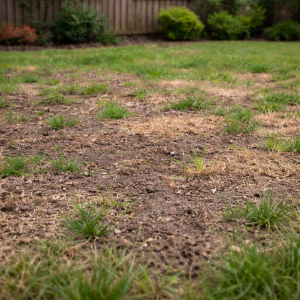
You moved into a new home with fresh sod, set the controller as the builder suggested, and watched the lawn thin out anyway. By the second summer it’s patchy, browns in the heat, and sheds water off the edges. More watering doesn’t help.
It’s a familiar story in the Treasure Valley’s newer subdivisions, and it’s rarely the homeowner’s fault. At Idaho Organic Solutions, we work on lawns in Meridian, Kuna, Star, and the surrounding growth areas, and a struggling new lawn usually traces back to the soil the builder left behind.
Why New-Build Lawns Struggle
NC State Extension explains that during most new home construction, the topsoil and subsoil are removed from the building area and then used around the foundation during final grading. The soil has to be compacted for construction strength, but compacted soil restricts water movement and root growth. When lawns are built on that compacted subsoil, homeowners inherit the problem.
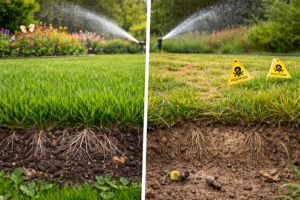
The result is a lawn with a few inches of loose material over a dense layer that roots can’t penetrate. The pattern shows up in several ways:
- Shallow roots: Grass roots stop where the compacted layer begins, so the lawn dries out quickly in July heat.
- Runoff and puddling: Water can’t soak in fast enough, so it runs off slopes or sits in low spots.
- A saturated upper layer: Water soaks the loose surface material, then stalls at the dense layer below, leaving roots short on oxygen.
- Sod that never knits in: New sod stays loose and can be lifted in sections a year or more after installation.
Treasure Valley soil adds its own challenge. University of Idaho Extension’s Canyon County Master Gardeners note that local soils run high in pH, which affects how well plants absorb nutrients. Compaction and alkalinity together make a tough start for new turf.
Is It the Soil or Something Else?
Before blaming the soil, rule out the simpler causes. New subdivisions often have brand-new sprinkler systems that were never adjusted for full coverage, and pressurized irrigation can be intermittent during the first weeks of each season. Our guide to Treasure Valley pressurized irrigation covers who runs your system and what’s normal.
Then test the soil itself.
The screwdriver test
A day after watering, push a long screwdriver straight down into the lawn in several spots. In healthy, moist soil it should slide in several inches with steady pressure. If it stops hard after an inch or two across most of the yard, you’ve found the compacted layer.
Utah State University Extension recommends soil probes for exactly this purpose, noting that probes can check for compacted layers and that 6 to 12 inches of moist soil is enough for a lawn. If your screwdriver can’t get anywhere near that depth, your grass can’t either.
The tug test
Grab a handful of grass and pull. Sod that lifts in a mat with short, flat roots underneath hasn’t rooted into the native soil. Grass that tears at the blade is anchored.
The water test
Run one zone and watch. If water runs off or puddles within a few minutes, the soil can’t absorb it as fast as your sprinklers apply it. Shorter, repeated cycles (cycle and soak) help in the meantime.
What Actually Fixes It
There isn’t a single product that loosens compacted subsoil. The right approach depends on how severe the problem is.
| Severity | What you’ll see | Recommended approach | Realistic timeline |
|---|---|---|---|
| Mild | Screwdriver goes in with moderate effort in most areas; some thin spots | Annual core aeration, compost topdressing, fall overseeding | One to two seasons |
| Moderate | Screwdriver stops within the top couple of inches in most areas; runoff and summer browning | Aeration spring and fall, compost topdressing after each pass, overseeding, adjusted watering | Two seasons or more |
| Severe | Sod never rooted; hard layer right under the sod; large dead areas | Remove failing turf, till compost into the soil, then reseed or resod | One season to rebuild, plus establishment time |
Core aeration and topdressing
Core aeration pulls plugs of soil out of the lawn and opens channels for air, water, and roots. Spreading a thin layer of compost after aeration lets organic matter fall into those holes and gradually improve the upper root zone. It’s the least disruptive option and the right starting point for mild compaction.
Be realistic about its limits. NC State Extension notes that core aeration in a compacted soil doesn’t directly increase water movement through the soil. It helps the surface; it doesn’t break up a deep, dense layer in one pass.
Rebuilding the soil
For severe cases, the fix happens before the grass goes in. NC State Extension recommends tilling compacted soil, and says topsoil or amendments should be tilled into the existing soil instead of spread on top of it. Their research summary found that tilling to six inches with compost produced the highest water infiltration of the methods compared. University of Wisconsin Extension gives similar advice: mix amendments into the existing soil and work it to a depth of 4 to 6 inches before sodding or seeding.
Our step-by-step guide on rebuilding Idaho soil from clay to living soil goes deeper on amendments.
Reseeding or resodding
Once the soil is corrected, you can overseed thin areas or start over with new sod. Our comparison of sod vs. seed costs in Nampa can help you decide, and our guide to the best grass for Idaho soil covers which varieties hold up here.
A One-to-Two-Season Recovery Plan
For most new-build lawns with moderate compaction, this sequence works well:
- Late summer or early fall: Core aerate, topdress with compost, and overseed.
- Fall: Keep the seed moist until it establishes, then return to deep, less frequent watering.
- Spring: Aerate again once the lawn is actively growing and check the screwdriver depth.
- Summer: Water deeply and less often to push roots down. Watch for thin spots.
- Following fall: Repeat aeration and overseeding where needed.
If the screwdriver depth hasn’t improved after two seasons, the compacted layer is likely too deep for surface work, and rebuilding is the better investment.
Frequently Asked Questions
Why is my new sod dying even though I water it every day?
Daily watering on compacted soil keeps the surface wet while roots stay shallow and short on oxygen. The grass looks drought-stressed because its roots can’t reach deeper moisture. Test for compaction before adding more water.
How do I know if my soil is compacted?
Push a long screwdriver into moist soil. If it stops hard after an inch or two across most of the lawn, the soil is compacted. Runoff and puddling after short watering cycles are other signs.
Does aeration fix compacted soil?
Core aeration improves the surface and helps roots and water enter the top few inches. It won’t break up a deep compacted layer in one pass. Severe compaction usually needs tilling with compost before replanting.
Should I add topsoil on top of my new lawn?
Not as a thick layer. Extension research recommends mixing amendments into the existing soil. A loose layer spread over compacted ground can hold water above the dense layer and keep roots shallow.
How long does it take to fix a new-construction lawn?
Mild to moderate compaction usually improves over one to two seasons of aeration, compost topdressing, and overseeding. A full rebuild takes one season of work plus time for new grass to establish.
Start With the Soil
A new-construction lawn that won’t thrive usually has a soil problem underneath it. Test with a screwdriver, correct your watering, and choose the level of repair that matches what you find. If you’d like help, Idaho Organic Solutions works throughout Meridian, Kuna, and Star, and we can assess your soil and recommend a plan.
Request a free estimate to get started.