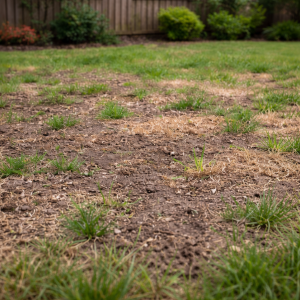
Idahoian soil is problematic, yes — so what’s next?
The good news is that it’s entirely possible to fix and revitalize both your lawn and the soil underneath through organic lawn treatments. Here’s what decades of experience at Organic Solutions has taught us about transforming Nampa’s broken soil into something that actually supports a healthy lawn.
The Living Soil Food Web
One teaspoon of healthy soil contains between 100 million and 1 billion bacteria. Add fungi, protozoa, nematodes, and visible creatures like earthworms, and you’re looking at an entire ecosystem in a handful of dirt.
This is the foundation of every healthy lawn.
Here’s what they actually do:
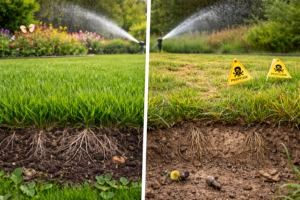
- Bacteria and fungi break down organic matter – dead leaves, grass clippings, compost – into forms grass can absorb. Without them, all that plant debris just sits there. Chemical fertilizers short-circuit this process by providing nutrients directly, so the soil microbes never get activated. Over time, soil biology dies off.
- Earthworms tunnel through compacted clay, creating pores for air and water. Their waste (castings) is one of the most nutrient-rich substances on your property. A single healthy lawn can have millions of earthworms. A chemically treated lawn often has none.
- Mycorrhizal fungi form partnerships with grass roots, extending the plant’s ability to access water and nutrients far beyond what the root system alone could reach. This is why organic lawns develop deeper roots and drought tolerance – the fungi do the work.
This entire food web collapses in alkaline, low-organic-matter soil. The microbes can survive, but they’re not active. You need to wake them up by giving them what they need: organic matter to eat.
Testing Your Soil: The Essential First Step
You can’t fix what you don’t understand. That’s why a professional soil test – costing between $65–$100 – is a must-do for your first step. The test reveals pH, nutrient levels, and organic matter content of the soil. The result will inform your entire amendment strategy.
For instance, Nampa’s alkaline soil will typically need an application of sulfur to lower pH. The rate informs us of exactly how much your soil will need – applying the wrong amount creates more problems.
Soil tests also reveal nutrient deficiencies. Iron deficiency (iron chlorosis) is common in Nampa because the alkalinity locks up iron (USU Extension). Nitrogen might be low because the soil lacks active microbes to release it from organic matter. Phosphorus or potassium might be adequate in total but unavailable because of pH issues. The test clarifies what you’re actually dealing with.
You should test annually, especially when transitioning to organic management. Year-to-year changes show whether your amendments are working.
Rebuilding Soil Structure
Most of Nampa’s clay soil is compacted, so grass roots are unable to penetrate it. This means water runs off instead of infiltrating and doesn’t reach the root zone. All the organic matter in the world won’t fix this without addressing compaction first.
Step 1: Core Aeration
Core aeration creates tiny holes in the soil, removing small plugs and allowing water, air, and amendments to reach down.
Schedule aeration for April–May or September–October when soil is moist but not waterlogged. Fall aeration has an advantage – it supports root growth throughout fall and into winter, setting up strong spring growth.
Step 2: Organic Matter Incorporation
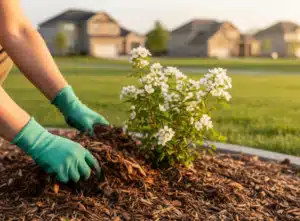
Organic matter incorporation follows aeration. Work 1–2 inches of quality compost into the aeration holes. This introduces beneficial microorganisms and organic material that alkaline soils need.
Step 3: Mulch-Mowing for Continuous Improvement
Mulch-mowing gradually adds organic matter without special effort. Leave grass clippings on the lawn instead of bagging them. As they decompose, they return nitrogen and organic carbon to the soil. Same with leaves in fall – mulch them with your mower instead of raking them away.
Over time, this organic matter accumulation changes soil structure. Clay particles aggregate into clumps, creating pore spaces. Water infiltration improves. Compaction decreases naturally. The transformation may take a couple of years, but it’s genuine and, more importantly, lasting.
Why This Approach Works in Nampa
The key is understanding that Nampa’s soil problems are interconnected. You can’t just lower pH without adding organic matter. You can’t just add organic matter without addressing compaction. You can’t just aerate without providing something for the microbes to eat.
This is why organic lawn care starts with soil and why a soil-first approach is the only approach that produces lasting results in our region.
FAQ
How long does it actually take to rebuild soil in Nampa?
Most noticeable improvements appear by year two or three, but the full transformation takes 3–5 years. Organic matter goes from less than 1% to 2–3%, compaction decreases measurably, and biological activity increases significantly. By year three, your lawn requires substantially less water, fertilizer, and pest management because the foundation is stronger.
Can I rebuild soil myself, or do I need a professional?
Both work. Professional soil testing ($65–$100) and aeration ensure proper technique and timing. Mulch-mowing (leaving clippings and shredded leaves) is easy DIY and costs nothing. Many homeowners hire professionals for soil testing and aeration in year one, then maintain through mulch-mowing and annual monitoring. This hybrid approach gives you the foundation while minimizing costs.
What’s the difference between sulfur and other pH-lowering products?
Sulfur is slow but stable – it gradually lowers pH without drastic swings that shock the soil ecosystem. It works best when soil microbes are active (spring). Other products like aluminum sulfate work faster but can create imbalances. Compost is gentler still, moderating pH naturally through organic acids. For Nampa’s conditions, sulfur plus compost is the most sustainable combination.
Will adding organic matter help if my soil is still super compacted?
No – aeration must come first. Compost added to hard-packed clay just sits on top or works only into the top inch. Aeration creates channels where compost can reach deeper. This is why the order matters: aerate first, then incorporate compost into the aeration holes, then mulch-mow to gradually add more organic matter over time.
How do I know if the soil rebuilding is actually working?
Annual soil testing shows changes in pH, organic matter percentage, and nutrient availability. Visual signs: better water infiltration (water soaks in instead of pooling), deeper root penetration (you can push a screwdriver deeper each year), more earthworms, thicker grass with fewer bare patches. By year two, these signs become obvious. By year three, the difference is dramatic.
Getting Started
Before choosing a specific lawn care program, understand your soil. Get it tested. Learn your pH, organic matter level, and what specific nutrients are actually available to grass. Then work with amendments and methods designed for your specific situation.
The difference between a lawn that always needs you and a lawn that mostly maintains itself starts with three inches below the surface.
Schedule Your Free Soil Assessment & Custom Restoration Plan – Organic Solutions will test your soil, explain the results, and create a step-by-step timeline for rebuilding your specific property.
Call Organic Solutions! Inc.: 208-884-8986