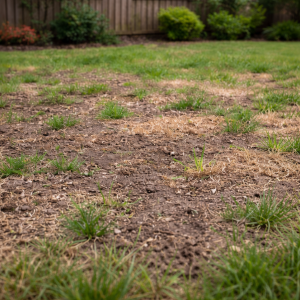
You mow your lawn on Saturday, and by Wednesday there are these coarse, ashy-green clumps already shooting back up above everything else. They don’t look like the rest of your grass, they grow faster than the rest of your grass, and no matter how many times you pull them, they keep coming back in roughly the same spots. If that sounds familiar, you’re probably not looking at a “weird patch” of your lawn grass — you’re looking at quackgrass.
It’s one of the most frustrating weeds we deal with on lawns around Nampa, Meridian, and the rest of the Treasure Valley, mostly because it’s so easy to mistake for something else until it’s already spread. Here’s how to identify it, why it’s such a problem, and what actually works to get rid of it.
What Is Quackgrass, Exactly?
Quackgrass (Elymus repens, sometimes labeled Agropyron repens) is a cool-season perennial grass (North Dakota State Library). Unlike most lawn weeds, it’s not a broadleaf plant you can easily spot by its shape — it’s an actual grass, which is exactly why it blends in until it doesn’t.
According to Purdue University’s Turfgrass Science program, large, nearly pure patches of quackgrass tend to form in lawns due to the plant’s invasive growth habit, extensive rhizome production, and allelopathy — meaning it actually releases chemicals that suppress the growth of other plants around it. Those patches typically stand out because of their ashy, blue-green color compared to the surrounding turf.
How to Identify Quackgrass
Quackgrass can look a lot like crabgrass, tall fescue clumps, or even some pasture grasses at first glance. A few features help separate it from the rest of your lawn:
- Color and texture: Coarser texture and a distinct ashy or blue-green color compared to surrounding turf
- Growth rate: Grows noticeably faster than the lawn around it, creating uneven height within days of mowing
- Clasping auricles: Purdue identifies this as the most distinct identification feature — small, claw-like projections where the leaf blade meets and wraps around the stem
- Seed heads: Later in the season, quackgrass produces spike-like seed heads that can reach up to 8 inches long, with two distinct rows of seeds
But the real giveaway is underground.
The Root of the Problem — Literally
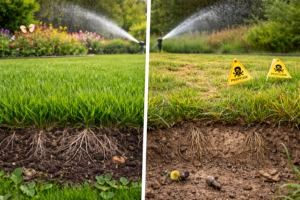
If you dig down a few inches near a quackgrass clump, you’ll find the feature that makes this weed so hard to deal with: rhizomes. These are thick, white-to-yellowish underground stems with sharp, pointed tips, and they’re the reason quackgrass spreads the way it does.
These rhizomes are long-lived, slender, and white with sharp tips, and they can stretch out several feet, producing new roots and shoots every few inches along the way. Each node on a rhizome is essentially a new plant waiting to happen — break off a piece during digging or tilling, and you can end up creating several new quackgrass plants instead of removing one.
This is why so many DIY removal attempts backfire. If you just rip the top off or lightly till the surface, broken rhizome pieces left behind can sprout entirely new plants, turning one patch into several.
Why You Can’t Just Spray and Walk Away
Quackgrass is a cool-season perennial grass, which means standard broadleaf weed killers — the kind that work great on dandelions and clover — don’t touch it. It’s a grass, so it takes a grass-killing approach, and that creates a problem: most products that kill grass don’t know the difference between quackgrass and your lawn.
According to Purdue’s turf experts, only nonselective control options currently exist for quackgrass in cool-season lawns, meaning spot-treatment with a nonselective systemic herbicide is typically the only chemical route — and it will kill your desirable turf in that spot too. The current recommended approach for larger infestations involves multiple herbicide applications spaced several weeks apart, followed by reseeding once the rhizomes have been exhausted.
Tillage isn’t a shortcut either. Soil disturbance near a quackgrass patch can actually help the weed spread, since chopped-up rhizomes are exactly what allows it to propagate into new areas.
So What Actually Works?
For homeowners dealing with a patch or two — rather than a quackgrass-dominated field — there’s a more practical path that doesn’t involve nuking a section of your yard:
- Dig it out, rhizomes and all. Dig deep and wide enough to capture as much of the rhizome system as possible. Don’t compost what you pull — bag it and dispose of it, since rhizome fragments can resprout.
- Don’t till the area. Tilling chops rhizomes into pieces that can each become a new plant. Power raking or light scarifying is preferable when prepping for reseeding.
- Backfill and overseed. Once the patch is cleared, fill with good topsoil and overseed with a turf mix that matches the rest of your lawn.
- Consider sod for previously-infested areas. Laying sod can be more effective than seeding in spots with a history of quackgrass, since established sod makes it harder for any remaining rhizome fragments to surface.
- Build a thick, healthy lawn. A dense, vigorously growing lawn is the best first line of defense against quackgrass and most other weeds, since it leaves quackgrass less open space to establish in the first place.
Quackgrass vs. Other Lawn Grass Problems
It helps to know what you’re not dealing with. Here’s how quackgrass compares to a few other grassy culprits homeowners often confuse it with:
| Feature | Quackgrass | Crabgrass | Tall Fescue Clumps |
| Life cycle | Perennial (returns every year) | Annual (dies with frost) | Perennial |
| Spreads by | Rhizomes and seed | Seed only | Seed (bunch-type, doesn’t spread by rhizome) |
| Color vs. lawn | Ashy, blue-green | Lighter green, sprawling | Often similar green, just coarser |
| Underground structure | Sharp white rhizomes | Fibrous roots, no rhizomes | Fibrous roots, no rhizomes |
| Removal difficulty | High — regrows from rhizome fragments | Moderate — pre-emergent control works well | Low to moderate — usually just dig and reseed |
Quackgrass FAQ
Is quackgrass the same as crabgrass?
No. Crabgrass is an annual weed that spreads only by seed and dies off with the first frost. Quackgrass is a perennial that spreads through both seed and an aggressive underground rhizome system, which is why it returns year after year and is much harder to eliminate.
Why does the quackgrass in my lawn grow so much faster than my other grass?
Quackgrass has a more vigorous growth habit than many common lawn grasses, which is part of why it stands out within days of mowing. Combined with its different color and coarser texture, this rapid regrowth is often the first thing homeowners notice.
Can I just pull quackgrass out by hand?
You can, but it has to be done carefully. The entire rhizome system needs to come out, because any fragments left in the soil can sprout into new plants. Hand-digging works best for smaller patches where you can excavate thoroughly.
Will regular weed killer get rid of quackgrass?
Standard broadleaf herbicides made for lawns generally won’t affect quackgrass since it’s a grass, not a broadleaf weed. Effective chemical control typically requires a nonselective herbicide applied directly to the quackgrass patch, which unfortunately will also kill any desirable turf it touches.
What’s the best long-term strategy for quackgrass-prone lawns?
Combine careful removal of existing patches — including the rhizomes — with practices that build a thick, dense lawn overall. Healthy, vigorously growing turf gives quackgrass far less open ground to colonize in the first place.
Let’s Get That Patch Sorted Out
Quackgrass is one of those problems that gets harder to fix the longer it sits, simply because every season gives the rhizome network more room to spread. If you’ve got a patch — or several — that just doesn’t match the rest of your lawn no matter how often you mow it, Idaho Organic Solutions can take a look and put together a plan that actually addresses the root system, not just the surface. From targeted removal to overseeding and lawn renovation for the bare spots left behind, we’ll help you get your lawn back to one uniform color and texture. Get in touch with Idaho Organic Solutions for a free assessment of what’s growing in your yard.