The assumption most people make about organic lawn care is that it’s more expensive than conventional chemical treatments. That assumption is sometimes true and sometimes completely wrong. The real answer is: It depends entirely on what you’re actually comparing.
Organic Solutions has been in the business for years, and, from us, here’s what you need to know about the real cost to get your lawn taken care of in Nampa and Canyon County.
Breaking Down Canyon County Pricing
Organic lawn care costs in Canyon County typically run between $75 and $150 per application for single services, with comprehensive programs ranging from $100 to $300 per month depending on lawn size and service frequency. To put that in perspective, conventional chemical-based lawn care in the Nampa area costs similarly – between $50 and $225 per treatment.
You’re not necessarily paying a premium for going organic, but a different set of materials and often a different level of expertise needed to apply them correctly.
What Influences Your Actual Cost
Several factors shift your total investment:
- Lawn size matters most: A 5,000 square foot residential lot costs less per application than a 15,000 square foot property. Most Canyon County providers calculate costs per application based on total footage, so the baseline shifts significantly depending on your property size.
- Frequency of service is the second major factor: A basic fertilization program requires 4–6 applications per year in Idaho’s climate. A comprehensive program that includes fertilization, weed control, aeration, and seasonal treatments runs more applications and therefore higher annual costs. Some properties need monthly attention during peak growing season.
- Soil condition affects initial costs: If your lawn has serious compaction, heavy thatch buildup, or significant nutrient deficiencies, the startup phase costs more. Initial aeration, dethatching, and soil amendments add expense upfront. Once the foundation is solid, maintenance costs drop.
- Treatment complexity in alkaline soils creates variations: Treasure Valley’s naturally alkaline soil (typically around 5.8 to 6.5, per UC Davis) sometimes needs specific amendments – sulfur to lower pH, iron chelate to address yellowing – that basic programs don’t include. These specialized additions increase costs.
Typical Cost Breakdown for a 7,500 sq ft Nampa Property
If you own a standard residential lot in Nampa or nearby Canyon County areas, here’s what you’d realistically expect to invest annually in an organic lawn program:
| Phase | Year 1: Foundation | Years 2–3: Maintenance | Year 3+: Established |
| Annual Cost | $1,200–$1,800 | $800–$1,400 | $600–$900 |
| What’s Included | Soil testing, aeration, compost amendments, 4–6 fertilizer applications, seasonal weed management | 4 annual fertilizer applications, annual aeration, ongoing weed management | 3–4 annual fertilizer applications, occasional amendments, aeration every other year |
| Why It Changes | Investment-heavy foundation building | Soil health improves, reducing intervention needs | Lawn handles itself better, maintenance stabilizes |
*These are ballpark figures. Your specific costs depend on your property’s starting point and what you’re comparing them against.
**Get a free assessment to understand your actual baseline costs.
Organic vs. Conventional: The Long-Game Comparison
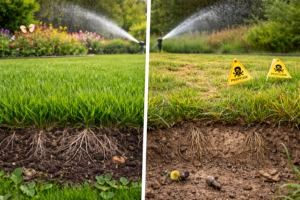
As you can see above, both conventional chemical-based lawn care costs roughly the same per application as organic treatment at $50–$150 per application. Where they really differ, though, are the results you get over time.
Chemical Lawns Cost More Long-Term
A chemical-dependent lawn typically needs more frequent applications because the effects are temporary.
Synthetic fertilizers need more frequent reapplication – sometimes 6–8 times per year instead of 4–6. Pest problems that develop from weakened soil can require additional herbicide and pesticide applications. That’s why, by our estimate, annual costs for conventional treatment can range from $800 to as high as $1,600.
Organic Costs Decrease Over Time
An organically managed lawn’s costs decrease as soil health improves. The lawn becomes less needy. You spend less on interventions. By year three or four, organic programs often cost 20–30% less annually than conventional programs for the same lawn size.
Service-by-Service Cost Comparison
| Service Type | Conventional (Per Application) | Organic (Per Application) | Annual Frequency |
| Fertilization | $50–$100 | $60–$110 | 4–6x/year |
| Weed control | $65–$90 | $75–$120 | 3–4x/year as needed |
| Aeration | $150–$200 | $150–$200 | 1–2x/year |
| Pest control (grub/billbug treatment) | $80–$120 | $100–$150 | 1–2x/year as needed |
| Soil amendments (compost, sulfur, etc.) | Not typically included | $100–$300 | 1–2x/year |
When we look at this from a purely financial perspective, organic is an investment in the first year or two that pays dividends later. Conventional is cheaper upfront but more expensive long-term as the results they build don’t tend to be sustainable.
DIY vs. Professional: The Hybrid Approach
Some homeowners do parts of organic lawn care themselves – applying compost, hand-pulling weeds, managing irrigation. This reduces costs substantially but requires time, knowledge about application rates and timing, and sometimes equipment investment.
What You Can DIY (And Save Money)
- Aeration: Renting or buying a core aerator ($30–$100 per day rental, $500–$1,500 to purchase) and doing it yourself saves $80–$100 per application.
- Fertilizer application: Buying organic fertilizer in bulk and applying it yourself saves roughly $30–$50 per application compared to professional application.
- Basic maintenance: Mowing, irrigation management, and hand-pulling weeds require no special timing knowledge and reduce overall service needs.
What Requires Professional Timing and Knowledge
- Corn gluten meal application for crabgrass prevention has a narrow window (late March–mid-April in Canyon County). Missing it means zero effectiveness.
- Aeration timing and technique directly affects results – professionals understand soil moisture conditions and the right depth.
- Soil testing and pH adjustment requires knowing exact rates for amendments like sulfur based on your specific soil composition.
- Fertilization scheduling in Idaho’s climate involves precise timing to maximize nutrient uptake during growing seasons.
If you’re up to it, a lot of homeowners we’ve worked with have been quite happy with a hybrid arrangement: they handle simple mowing and irrigation, while our team helps with specialized services like aeration, soil testing, and fertilization.
FAQ
Why does year one cost so much more than years two and three?
Year one includes soil testing, aeration, compost amendments, 4–6 fertilizer applications, and seasonal weed management – this is investment-heavy foundation work. Years 2–3 drop significantly because soil health improves and the lawn needs fewer interventions. By year three, maintenance shifts to 3–4 annual applications and occasional amendments, stabilizing at the lowest cost.
Is organic really cheaper long-term than chemical if they cost the same per application?
Chemical lawns need 6–8 applications annually ($800–$1,600 total) because effects are temporary and pest problems often develop. Organic programs cost $1,200–$1,800 year one but stabilize at $600–$900 by year three as soil improves and the lawn becomes less needy.
What DIY tasks reduce costs without requiring specialized knowledge?
Simple tasks like mowing, irrigation management, and hand-pulling weeds can help you save money without requiring too specialized knowledge or exact timing.
Why do properties with alkaline soil sometimes cost more?
Nampa’s naturally alkaline soil sometimes needs specific amendments like sulfur to lower pH or iron chelate to address yellowing. These specialized additions don’t fit basic programs and increase costs.
How much will I save on water bills with organic management?
By year two or three, most organically managed lawns require 20–30% less irrigation because improved soil structure holds water more efficiently. For a typical Nampa property, this translates to $20–$40 monthly savings during summer months – offset against your lawn care program costs.
Ready to Understand Your Specific Costs?
Organic Solutions offers free initial assessments for Canyon County properties. We can provide actual pricing based on your soil condition, lawn size, and location within the Nampa area.
The first step is knowing exactly what you’re working with.
Get a Free Lawn Assessment & Custom Quote – Call 208-884-8986