If your Kentucky bluegrass lawn keeps developing dead rings and patches that return year after year no matter what you do, you are almost certainly dealing with necrotic ring spot. It is one of the most common and most frustrating lawn diseases in the Treasure Valley, precisely because our lawns are dominated by the bluegrass it loves. It is also notoriously stubborn, so understanding what it is and how to manage it makes all the difference between an ongoing battle and a lawn that finally recovers.
Necrotic ring spot is a fungal disease that attacks the roots and crowns of Kentucky bluegrass, causing rings and patches of dead grass, often with a tuft of green in the centre that gives a frog-eye look. It is common in Treasure Valley bluegrass lawns and hard to eradicate. Management focuses on relieving thatch and compaction with aeration, sensible watering and feeding, raising the mowing height, and overseeding the patches with more resistant grasses so they fill in.
Here is how to recognise necrotic ring spot, why it is so persistent, and how to manage it.
How to recognise it
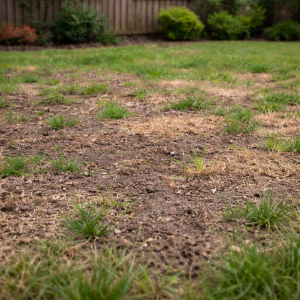
Necrotic ring spot has a distinctive look once you know it. It shows up as roughly circular rings and patches of dead, straw-coloured grass, ranging from a few inches to a couple of feet across. The classic tell is the frog-eye pattern, a ring of dead grass with a tuft of seemingly healthy green grass surviving in the middle, which sets it apart from many other lawn problems. The patches often appear in spring and fall during cool, wet conditions, and they tend to come back in the same spots year after year, sometimes merging into larger irregular dead areas over time. Because the fungus attacks the roots and crowns, affected grass pulls up easily with rotted, dark roots.
Why it targets our lawns
There is a simple reason necrotic ring spot is such a Treasure Valley problem: it specifically attacks Kentucky bluegrass, and bluegrass is the dominant lawn grass across the valley. Our lawns give the disease exactly the host it prefers. It is also favoured by the conditions many local lawns have, heavy thatch, compacted clay soil, and stress from our hot, dry summers, all of which weaken the grass and help the fungus take hold. Lawns that are several years old, sod-grown, and grown as a bluegrass monoculture are the most prone, which describes a great many yards here.
Why it is so stubborn
Necrotic ring spot has a reputation for being difficult, and it earns it. The fungus lives in the soil and attacks the root system, which puts it largely out of reach of surface treatments, and fungicides tend to give only limited, expensive and temporary control because of that. On top of that, the disease weakens the lawn in the same spots repeatedly, so those areas thin and die back again each year even after they seem to recover. This is why the effective approach is less about eradicating the fungus outright and more about strengthening the lawn and shifting the conditions so the grass can outgrow and resist it.
How to manage it
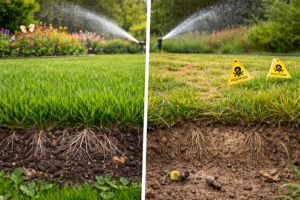
Managing necrotic ring spot is about cultural practices that reduce stress and strengthen the lawn, and these do more than any spray. Relieving thatch and compaction is central, so regular aeration and dethatching opens the soil, improves rooting and reduces the conditions the disease favours. Water deeply and infrequently in the early morning rather than shallow, frequent watering, so the lawn is neither drought-stressed nor left constantly damp. Feed sensibly with a balanced approach rather than heavy spring nitrogen, since forcing lush growth can worsen the disease, which is where a measured fertilizing program helps. Raise the mowing height to reduce stress on the grass. And build healthy, living soil, because a biologically active soil supports the grass and helps suppress soil-borne disease, which is the heart of an organic approach.
The most reliable long-term fix
The single most effective long-term strategy is to change the grass itself. Because the disease targets Kentucky bluegrass specifically, overseeding the affected areas and the wider lawn with more resistant grasses, such as perennial ryegrass and fescues, gradually shifts the lawn away from a vulnerable bluegrass monoculture toward a diverse mix the disease cannot devastate. These grasses fill in the dead patches and, over time, make the whole lawn far more resilient. Combined with the cultural practices above and delivered through a steady lawn care program, overseeding with resistant grasses is what finally breaks the yearly cycle for most lawns.
Frequently Asked Questions
What does necrotic ring spot look like?
It appears as roughly circular rings and patches of dead, straw-coloured grass, from a few inches to a couple of feet across, often with a tuft of green grass surviving in the centre, the classic frog-eye pattern. Affected grass pulls up easily with dark, rotted roots.
Why does my bluegrass lawn keep getting dead rings?
Almost certainly necrotic ring spot, a fungal disease that specifically attacks Kentucky bluegrass, which dominates Treasure Valley lawns. It lives in the soil, attacks the roots, and returns to the same spots year after year, especially in lawns with heavy thatch, compaction and summer stress.
How do I get rid of necrotic ring spot?
It is hard to eradicate because the fungus lives in the soil and attacks the roots, so fungicides give only limited control. The effective approach is cultural: relieve thatch and compaction with aeration, water and feed sensibly, raise the mowing height, and overseed with resistant grasses.
Do fungicides work on necrotic ring spot?
Only to a limited degree. Because the fungus attacks the root system in the soil, out of reach of surface treatments, fungicides tend to be expensive and give temporary, partial control at best. Strengthening the lawn and overseeding with resistant grasses works far better long term.
What grasses resist necrotic ring spot?
Perennial ryegrass and fescues are far less susceptible than Kentucky bluegrass. Overseeding affected bluegrass lawns with these grasses shifts the lawn toward a diverse, resistant mix over time, which fills the dead patches and makes the whole lawn more resilient.
When does necrotic ring spot appear?
The dead rings and patches typically show up in spring and fall during cool, wet conditions, and they often become most visible in the heat of summer when the weakened, poorly rooted grass cannot cope. The same spots tend to return year after year.
Break the yearly cycle
Necrotic ring spot is stubborn, but it is not unbeatable. The key is to stop chasing the fungus and start strengthening the lawn, relieving thatch and compaction, watering and feeding well, and gradually shifting to more resistant grasses, so your bluegrass lawn can finally outgrow the disease that keeps coming back.
Organic Solutions has diagnosed and managed necrotic ring spot in Treasure Valley lawns for over twenty years, from Nampa and Meridian to Boise, Eagle, Kuna and beyond. If dead rings keep returning to your lawn, request a free estimate or call us on 208 884 8986, and we will build a plan to finally break the cycle.