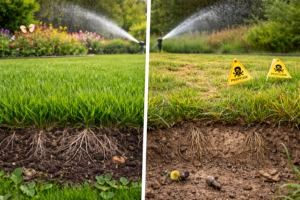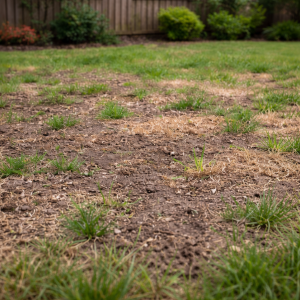
Your lawn looks tired. You’re doing everything right — watering on schedule, mowing regularly, fertilizing — but the grass still feels spongy underfoot, water pools on top instead of soaking in, and some patches won’t green up no matter what.
It’s tempting to blame the watering or the fertilizer. But the real answer might be sitting right at soil level, hidden under the grass where you’d never think to look.
We see thatch buildup on lawns across Nampa, Meridian, and the rest of the Treasure Valley all the time. Here’s how to tell if it’s behind your lawn problems, and what to do about it.
What Is Thatch, Anyway?
Thatch is that layer of organic material that builds up between the soil and the visible green grass. It’s dead and living stems, crowns, fibers, and roots — basically the parts of the grass plant that don’t break down easily.
Penn State Extension explains that thatch starts piling up when turf produces organic debris faster than the soil organisms can process it. About a quarter of thatch is lignin, which resists decay on its own — a big reason thatch can build up faster than it breaks down.
Here’s a myth that’s worth busting: grass clippings left on the lawn aren’t the cause. They break down quickly and barely add to thatch at all. The real contributors are the grass plant’s own stems, crowns, and roots, along with poor drainage, compacted soil, overwatering, and cutting too much off the blade at once.
A Little Thatch Is Actually Good
Here’s the part that surprises a lot of homeowners: thin thatch isn’t a problem. A thatch layer of around one-half inch or less is actually beneficial, helping to limit weed germination, reduce water evaporation from the soil, and even provide some protection against frost damage and temperature swings.
So the goal with thatch management isn’t to eliminate it completely — it’s to keep it from crossing the line from “helpful cushion” into “barrier that’s choking your lawn.”
When Thatch Becomes a Problem
Most university turf programs put the tipping point around half an inch. Below that, you’re fine. Above it, it’s worth putting together a thatch management plan.
Past an inch, thatch stops being harmless and starts working against you. It blocks water and fertilizer from reaching the soil, and traps roots inside the thatch layer itself, where they’re far more exposed to heat, drought, and stress. University of Maryland Extension also points out that thatch this thick gives pests like billbugs, chinch bugs, and sod webworm larvae a place to hide, along with disease-causing fungi — adding to the problem on top of the water and nutrient issues.
Signs Your Lawn Has Too Much Thatch
You don’t necessarily need to dig a soil sample to suspect a thatch problem. Watch for these signs:
- The lawn feels spongy or bouncy when you walk across it, even when the soil underneath should be firm
- Water runs off or pools instead of soaking in, even on level ground
- Bare or browning patches persist despite regular watering and fertilizing
- Grass looks stressed during hot weather faster than you’d expect, even with consistent irrigation
- You can see a brown, spongy layer at the base of the grass when you part the blades and look down
Of these, persistent bare or thin spots despite consistent care is often the biggest red flag — if your maintenance routine hasn’t changed but the results have gotten worse, thatch is a likely suspect.
How to Actually Check Your Thatch Layer
This takes about five minutes with a small shovel or trowel. Cut out a wedge of turf, roughly 2 to 3 inches across and a couple inches deep, down to bare soil. Pull it out and look at the cross-section — you’re looking for a brown or gray, stringy layer sitting between the green grass on top and the soil underneath.
Measure that layer with a ruler. Half an inch or less, you’re fine. Pushing toward an inch or beyond, it’s time to plan for dethatching.
Thatch Thickness at a Glance
| Thatch Depth | What It Means | Recommended Action |
| Under 1/2 inch | Healthy and beneficial — provides cushioning and insulation | No action needed |
| About 1/2 to 3/4 inch | Approaching the threshold | Monitor; consider dethatching if other stress signs appear |
| 3/4 inch to 1 inch | Starting to restrict water, air, and nutrients | Plan for dethatching |
| Over 1 inch | Significant barrier; roots growing into thatch layer itself | Dethatch and follow up with overseeding |
Why Dethatching Matters for the Rest of Your Lawn Care
Why Dethatching Matters for the Rest of Your Lawn Care
Heavy thatch blocks a lot of the lawn care you’re already doing. Fertilizer sits on top instead of reaching the soil. Water runs off instead of soaking into the roots. Even a perfectly-timed fertilizing schedule won’t do much if there’s a thick layer of organic material in the way.
That’s why dethatching often comes paired with lawn aeration. Aeration punches channels through the thatch into the soil, letting air, water, and roots through. Our aeration and dethatching service covers both — doing just one tends to leave the other problem untouched.
Bare patches after dethatching are common, especially with heavy thatch. Overseeding and lawn renovation fills those in with healthy turf before weeds get a foothold.
Timing Matters
For the cool-season grasses common in the Treasure Valley — Kentucky bluegrass, perennial ryegrass, fine fescue, and tall fescue — fall is generally the preferred window for dethatching. Soil temperatures are still warm enough to support recovery and any necessary overseeding, while the cooler air reduces stress on the lawn during the process. Dethatching during the heat of summer can put extra stress on grass that’s already working hard just to survive.
Thatch FAQ
How thick does thatch need to be before I should worry?
Anything under half an inch is normal. Once it’s past that, plan for dethatching. Past an inch, it’s actively working against you.
Does mowing and leaving grass clippings on the lawn cause thatch?
No — that’s a myth. Clippings decompose fast and barely matter. Thatch is mostly dead stems, crowns, and roots from the grass itself, plus compacted soil and overwatering.
How do I check my lawn’s thatch layer myself?
Cut a small wedge of turf — 2 to 3 inches across, a couple inches deep — down to the soil. Look for a brown or gray, spongy layer between the grass and the soil. Measure it.
What problems does too much thatch cause?
Past an inch, water, air, and nutrients can’t reach the roots. Roots stay shallow, growing in the thatch instead of the soil. Pests like chinch bugs and sod webworm larvae, plus fungi, also love hiding there.
When is the best time to dethatch a lawn in Idaho?
Fall works best. The soil’s still warm enough to support recovery and overseeding, and cooler weather puts less stress on the lawn.
Find Out What’s Going On Under Your Grass
If your lawn has been fighting an uphill battle despite consistent watering, mowing, and fertilizing, thatch buildup might be the missing piece. Idaho Organic Solutions can check your thatch layer, let you know exactly where it stands, and put together a plan — whether that’s aeration and dethatching now or simply keeping an eye on it for next season. Reach out to Idaho Organic Solutions for a free lawn assessment, and let’s get to the root of what’s holding your lawn back.