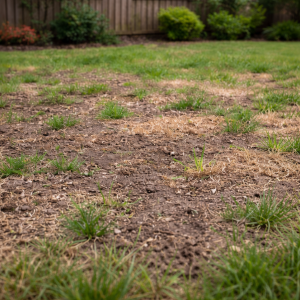
If you’re having a struggling lawn, odds are good that it’s not the grass that’s the issue – it’s the soil upon which the grass grows on. Nampa’s naturally alkaline, clay-heavy, organic-matter-starved soil creates conditions where even the healthiest grass have a very difficult time growing.
Organic Solutions has had years of experience fixing and improving on lawns across Idaho. Here are some things you might not know about the very soil beneath your feet!
The Idaho Soil Problem
Nampa and Canyon County sit on what geologists call the Snake River Plain. The native soil here is naturally alkaline – typically around pH 7.9, sometimes higher. It’s heavily clay-based, which means it compacts easily and drains slowly. And it’s desperately low in organic matter (University of Idaho).
Healthy soil should contain about 5% organic matter. Most Idaho soils contain less than 1% (Idaho Farm Bureau Federation). It’s not an exaggeration to say Nampa’s soil is starving.
Think of organic matter as what makes soil work for your plants. It’s the food source for beneficial microbes. It’s what holds onto water and nutrients instead of letting them drain away or lock up in forms grass can’t use. It’s the reason why an organic approach to lawn care focuses on rebuilding soil first – because without it, literally nothing else works.
Why This Matters for Your Lawn
The alkalinity issue gets worse when you add chemical fertilizers. Those synthetic products are designed to force quick nutrient availability, but in alkaline soil, many nutrients (especially iron) get bound up and unavailable to grass anyway. The result is yellowing grass despite heavy fertilization.
This cycle repeats year after year. You apply more fertilizer. Your grass stays weak. Weeds take over. You apply herbicides. The soil gets more damaged. By year three or four, you’re spending more money on fixes while your lawn looks worse.
What Healthy Soil Actually Looks Like
A lawn with healthy soil has certain characteristics that are absent in Nampa’s native conditions:
- Active drainage: Water infiltrates instead of running off
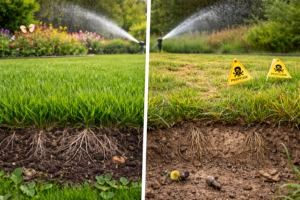
- Root penetration: Grass roots reach deep into the soil, not just the top inch
- Nutrient availability: Nutrients in the soil are accessible to plants, not locked up
- Biological activity: Billions of microorganisms break down organic matter and feed the grass
- Water-holding capacity: Soil holds moisture between waterings instead of releasing it immediately
Without these, your lawn will always be fighting against the foundation it’s planted in.
The Chemical Fertilizer Trap in Alkaline Soil
Chemical fertilizers are designed to work in neutral or slightly acidic soil. In Nampa’s high-pH environment, they create a very specific problem: nutrients become unavailable even though they’re present.
Iron chlorosis (yellowing grass despite fertilization) is the clearest sign of this problem (USU Extension). The iron is there. Your soil has it. But the pH locks it up so tightly that your grass can’t access it.
The conventional solution? Apply organic fertilizers like iron chelate. This provides temporary relief. The grass greens up for a few weeks. Then yellowing returns because the underlying problem – the pH – hasn’t changed.
You’re not building a healthier lawn. You’re buying time with increasingly expensive treatments.
The Compaction Problem
Clay soil compacts easily. Winter weight, spring runoff, foot traffic, and mower passes all compress clay particles together. Once compacted, water can’t penetrate. Roots can’t expand. Air can’t reach the root zone.
When water can’t infiltrate, it runs off – carrying fertilizer, organic matter, and soil particles away. This is why you see erosion on slopes and why water pooling appears after rain even in well-sloped yards.
Most lawns in Nampa have severely compacted soil within the top 4–6 inches. Without addressing this, improving your lawn is nearly impossible.
The Organic Matter Crisis
Less than 1% organic matter in soil that should contain 5% is a crisis, not just a deficiency.
Organic matter is:
- The food source for beneficial bacteria and fungi
- What holds water in the soil so it doesn’t drain away
- What holds nutrients so they don’t leach below the root zone
- What buffers pH naturally
- What creates soil structure (the ability to stay loose and workable instead of rock-hard)
Without rebuilding organic matter, you can’t solve the pH problem, the compaction problem, or the nutrient availability problem. They’re all interconnected.
This is why organic lawn care in Nampa must start with soil. Not grass. Not fertilizer. Soil.
FAQ
What’s wrong with my soil if grass won’t grow even with fertilizer?
Nampa’s alkaline soil (pH 7.9) locks up nutrients so they’re unavailable to grass even when present. Combined with less than 1% organic matter and heavy clay compaction, the soil can’t support grass growth. Chemical fertilizers don’t solve this because they can’t change the underlying pH or structure.
Is my yellowing lawn a disease or a soil problem?
Yellowing grass in Nampa is almost always iron chlorosis caused by alkaline soil locking up iron. The only exception is if the grass looks patchy and the yellowed patches seem localized. In that case, it might be a disease. If it’s yellowing across the whole lawn despite fertilization, it’s your soil. Get a soil test to confirm pH and available iron levels.
Can I just add more fertilizer to fix low organic matter?
No. Organic matter and fertilizer are different things. Fertilizer provides nutrients. Organic matter provides structure, water-holding capacity, and biological activity. You need both, but fertilizer alone won’t fix a soil starving for organic matter. You need to add actual organic material – compost, aged leaves, clippings.
How do I know if my soil is compacted?
Try pushing a metal rod or screwdriver into your soil. In healthy soil, it slides in easily to 6+ inches. In compacted clay, it stops at 2–4 inches and resists pressure. You can also dig a small hole and observe: if water sits in it rather than draining within a few minutes, compaction is severe. Most Nampa lawns have compaction in the top 4–6 inches.
Should I get a soil test before doing anything else?
Yes. A soil test ($65–$100) reveals your pH, nutrient levels, and organic matter content. This data determines everything else – what amendments you need, how much sulfur to apply, which nutrients are actually available. Without testing, you’re guessing. With testing, you can create a plan that matches your actual soil, not a generic approach.
What You Need to Know Before Moving Forward
Your lawn’s future depends on understanding what’s actually wrong with your soil. Nampa’s conditions are specific and require specific solutions. Chemical approaches fail here because they can’t address the root causes – alkalinity, compaction, and organic matter deficiency.
The good news? These problems are fixable. Once you understand your soil’s actual composition, you can create a plan that builds real, lasting health instead of temporary fixes.
The first step is always soil testing. Once you understand what you’re working with, real improvement becomes possible.
Schedule Your Free Soil Assessment – Organic Solutions’ team will come over and test your soil and explain exactly what’s preventing your lawn from thriving.
Call Organic Solutions! Inc.: 208-884-8986