Walk into any garden center and you’ll find shelves of fertilizer products promising thicker grass, greener color, and faster growth. Most of them are synthetic quick-release nitrogen formulas that force fast top growth and leave your soil no healthier than it was before. For Idaho homeowners trying to build a genuinely resilient lawn, that approach creates a frustrating cycle: the grass looks good for a few weeks, then fades, then needs another application.
Organic fertilization works differently. It focuses on building the soil food web, the community of bacteria, fungi, earthworms, and other organisms that convert organic matter into plant-available nutrients naturally. In Idaho’s challenging alkaline soils, this approach doesn’t just feed your grass; it gradually fixes the underlying conditions that make Treasure Valley lawns hard to manage in the first place.
Here’s a deep look at what organic fertilizers work best in Idaho, why they outperform synthetics over time, and how to use them correctly for your specific lawn.
The Idaho Soil Problem: Why Standard Fertilizer Often Disappoints
Before discussing what to apply, it helps to understand what you’re working with. Treasure Valley soils present a specific set of challenges that make standard fertilization strategies less effective than they should be.
High pH limits nutrient availability. Idaho soils typically run pH 7.5 to 8.5. At these alkaline levels, iron, zinc, manganese, and phosphorus become chemically locked in forms that grass roots can’t absorb, even when those nutrients are present in the soil. This is why Idaho lawns so often show yellowing (iron chlorosis) despite regular fertilization the nutrients are there, the roots just can’t reach them.
Clay soils reduce fertilizer efficiency. The Treasure Valley’s clay-dominant soils don’t just compact easily they also bind to synthetic fertilizer salts and reduce the amount of nutrition that actually reaches grass roots. Clay also creates uneven water distribution, with some areas staying waterlogged while others dry out quickly.
Low organic matter content. Unlike the rich prairie soils of the Midwest, Idaho soils tend to be naturally low in organic matter often below 2%, compared to the 4-6% ideal for healthy turf. Low organic matter means fewer soil microbes, less nutrient cycling, and reduced water-holding capacity.
Summer heat and drought stress. Treasure Valley summers regularly exceed 100°F, creating extended periods of heat stress that increase fertilizer burn risk with synthetic products and demand more from grass root systems than the soil can typically support.
Organic fertilization addresses all of these problems simultaneously. It feeds the grass while also improving pH buffering, building organic matter, enhancing microbial activity, and reducing the salt load in the soil.
Our lawn care program is built around this soil-first philosophy treating the underlying conditions rather than just masking the symptoms.
How Organic Fertilizers Work (And Why They’re Different)
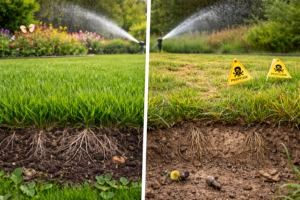
Synthetic fertilizers deliver nutrients directly to plants in immediately soluble form. The results are fast and visible but they bypass the soil food web entirely, doing nothing to improve the biology that sustains long-term lawn health. Over time, repeated synthetic applications can actually degrade soil biology, reduce microbial diversity, and increase dependence on external inputs.
Organic fertilizers work through the soil food web. Organic nitrogen, phosphorus, and potassium are bound in carbon-based molecules that soil microbes must break down before plant roots can absorb them. This decomposition process:
- Releases nutrients gradually, feeding grass over weeks rather than days
- Feeds the bacterial and fungal communities that power nutrient cycling
- Adds carbon to the soil, building organic matter and improving structure
- Reduces pH over time through the acids produced during decomposition
- Eliminates burn risk because soluble salt concentrations remain low
The trade-off is that organic fertilizers work more slowly than synthetics. You won’t see a burst of dark green growth within days of application. What you will see over the course of a season is steadier color, stronger root development, better drought tolerance, and a lawn that gradually requires less intervention to look its best.
The Best Organic Fertilizers for Idaho Lawns
Not all organic products are equally suited to Idaho’s conditions. Here’s a breakdown of the most effective options and how they address the specific challenges of Treasure Valley soils.
Compost and Compost-Based Fertilizers
Compost is arguably the single most valuable amendment for Idaho lawns. A quarter-inch topdressing of quality compost applied after aeration delivers multiple benefits at once:
- Adds organic matter that improves soil structure and water-holding capacity
- Introduces diverse populations of beneficial soil microbes
- Provides a slow-release source of all essential nutrients, including trace minerals
- Gently buffers soil pH toward the neutral range over time
For maximum benefit, apply compost immediately after aeration so it falls into the core holes and makes direct contact with the root zone. For severely depleted soils, annual compost topdressing produces measurable improvement in organic matter content within 2 to 3 years.
Feather Meal and Blood Meal
These nitrogen-rich organic materials are among the most concentrated sources of plant-available nitrogen in organic form.
Feather meal (12-0-0 typical analysis) releases nitrogen slowly as soil microbes digest it, providing steady feeding over 3 to 4 months. It’s an excellent choice for Idaho’s cool-season lawns when applied in early fall, providing nitrogen that supports root development going into winter without driving excessive top growth.
Blood meal (12-0-0 to 13-0-0) releases more quickly than feather meal, making it useful when faster greening is needed. It also has a mild acidifying effect on soil pH a meaningful benefit for alkaline Idaho soils. Use it in spring when you want to jumpstart color after winter dormancy.
Both products have strong odors upon application that dissipate within a few days as the material is absorbed into the soil.
Bone Meal and Rock Phosphate
Phosphorus is the nutrient most affected by Idaho’s high pH, making supplementation particularly important here.
Bone meal (3-15-0 typical) provides a concentrated source of phosphorus in organic form. It’s essential when overseeding because phosphorus drives root development in germinating seedlings. Apply it alongside overseeding in fall to support both new seedling establishment and existing grass root depth heading into winter.
Rock phosphate releases phosphorus even more slowly than bone meal, making it better suited for soil building than immediate correction. In severely phosphorus-deficient Idaho soils, rock phosphate incorporated during landscape renovation provides a long-term phosphorus reservoir that slowly becomes available as soil pH improves.
Kelp Meal and Liquid Kelp
Kelp meal is made from dried seaweed and contains modest amounts of nitrogen and potassium alongside a remarkable range of trace minerals, growth hormones (cytokinins and auxins), and compounds that stimulate microbial activity.
In Idaho’s nutrient-limited soils, the micronutrient content of kelp is particularly valuable. Iron, zinc, manganese, and boron all commonly deficient in alkaline Idaho soils are present in kelp in organic forms that remain available even at high pH.
Liquid kelp extracts can be applied as foliar sprays for faster absorption, bypassing soil pH entirely and delivering micronutrients directly to grass blades. This makes liquid kelp especially useful for correcting iron chlorosis in Idaho lawns, the yellowing that occurs when alkaline soil locks out iron even when adequate amounts are present.
Corn Gluten Meal
Corn gluten meal (CGM) is unique among organic fertilizers because it serves double duty: it provides slow-release nitrogen (approximately 10% N by weight) while also suppressing weed seed germination. The proteins in corn gluten interfere with root formation in germinating seeds without affecting established plants.
For Idaho lawns, corn gluten applied in early spring when soil temperatures reach 50 to 55°F can reduce crabgrass germination while feeding the lawn simultaneously. It’s important to note that corn gluten inhibits ALL seed germination, including grass seed, so it must not be used in the same season as overseeding.
Our weed control programs incorporate corn gluten as part of a broader organic weed management strategy that reduces chemical input while maintaining effective control.
Humic and Fulvic Acids
Humic and fulvic acids aren’t fertilizers in the traditional sense they don’t supply significant amounts of NPK. But they’re among the most important soil amendments for Idaho’s alkaline, compacted soils.
Humic acids improve soil structure by binding clay particles into aggregates, creating pore spaces for air and water movement. They also chelate (bind to) mineral nutrients like iron and manganese, holding them in plant-available form even in high-pH conditions directly addressing Idaho’s micronutrient availability problem.
Fulvic acids are smaller molecules that penetrate plant root membranes and carry chelated nutrients directly into plant tissue. When applied as a soil drench, they enhance the efficiency of every other fertilizer applied alongside them.
A Seasonal Organic Fertilization Schedule for Idaho Lawns
Organic fertilization works best as a planned program rather than a series of one-off applications. Here’s a schedule designed for cool-season lawns in the Treasure Valley:
Early Spring (March–April): Apply a balanced organic fertilizer (blood meal or balanced pelletized organic blend) as the lawn breaks dormancy. This supports early greening without driving excessive top growth that demands frequent mowing. Add a liquid kelp foliar spray to address any iron chlorosis visible from the previous season.
Late Spring (May–June): A lighter application of slow-release nitrogen keeps the lawn green entering summer without overstimulating growth during the first heat waves. This is also the window for applying humic acid to improve soil structure before summer stress.
Summer (July–August): Reduce or eliminate nitrogen applications during peak summer heat to avoid stress. Focus on humic acid, kelp, and deep, infrequent irrigation to support root health. Our fertilizing services adjust application rates and products based on current temperatures to protect your lawn during Idaho’s hottest months.
Early Fall (Late August–September): This is the most important fertilization window of the year. A heavier application of slow-release nitrogen (feather meal, pelletized organic blend) combined with bone meal for phosphorus and a compost topdressing after aeration drives deep root development going into winter. Lawns fertilized well in early fall emerge from winter significantly stronger than those that weren’t.
Late Fall (October–November): A final light nitrogen application sometimes called a “winterizer” just before dormancy provides nutrients that the grass stores in its roots, fueling a faster spring green-up.
What About Organic Fertilizer and Idaho’s Water Quality?
One reason Idaho homeowners increasingly choose organic fertilizers goes beyond lawn health: environmental responsibility. The Treasure Valley’s rivers, canals, and groundwater are interconnected in ways that make runoff from lawns a genuine concern.
Synthetic fertilizers, particularly quick-release nitrogen products, are prone to leaching into groundwater and running off into waterways during rain events and irrigation. Nitrate contamination of drinking water is a documented issue in parts of the Treasure Valley.
Organic fertilizers dramatically reduce this risk. Because nutrients are released slowly through microbial digestion rather than dissolving immediately in water, very little organic nitrogen ends up in runoff. The organic matter they add to soil also improves water retention, reducing the total irrigation water needed and the volume of runoff generated.
Choosing organic fertilization is both a soil health decision and a community health decision for Idaho families.
Organic Fertilizer and Soil Testing: Getting the Foundation Right
No organic fertilization program is fully effective without knowing your baseline soil conditions. Idaho soils vary considerably even within a single neighborhood in pH, organic matter content, and specific nutrient levels. A soil test tells you exactly what your lawn needs and prevents the common mistake of applying nutrients that are already adequate while missing deficiencies that are limiting growth.
Most university extension labs (University of Idaho Extension offers affordable soil testing) will analyze pH, organic matter, nitrogen, phosphorus, potassium, and key micronutrients. The results let you target your organic inputs precisely rather than guessing.
Our lawn care program begins with a property assessment that includes soil evaluation, so every treatment plan is grounded in what your specific lawn actually needs, not a generic formula.
Frequently Asked Questions
Are organic fertilizers safe for kids and pets?
Yes this is one of the most important advantages of organic fertilizers for Idaho families. Most organic products are derived from plant or animal materials that pose no toxicity risk to children or pets after application. Unlike synthetic fertilizers, which typically require a waiting period before the lawn is safe to use, most organic applications allow immediate re-entry. This matters especially for Idaho families whose kids and dogs spend significant time in the yard.
How long does it take to see results from organic fertilizer?
You’ll typically notice improved color within 2 to 4 weeks of an organic nitrogen application, depending on soil temperature and microbial activity. Cooler soil in early spring slows microbial breakdown, so early applications take longer to produce visible results. The more significant improvements deeper root development, better drought tolerance, improved soil texture develop over a full growing season as organic matter accumulates and soil biology rebuilds.
Can I use organic fertilizers on a lawn that’s already received synthetic fertilizers?
Absolutely. Many homeowners transition from synthetic to organic programs gradually, and there’s no harm in beginning organic applications on a lawn with a history of synthetic use. The transition period typically one to two growing seasons may produce slightly less dramatic quick-green results than you’re accustomed to from synthetics, but the long-term trajectory is consistently better.
How do organic fertilizers address iron chlorosis in Idaho lawns?
Iron chlorosis (yellowing from iron deficiency despite adequate soil iron) is extremely common in Treasure Valley lawns because high pH locks iron in insoluble forms. Organic fertilizers help through two mechanisms. First, the organic acids produced during decomposition slightly acidify the soil over time, improving iron solubility. Second, chelated iron products and liquid kelp applications can deliver iron directly to plant tissue, bypassing the pH problem entirely. Our team can assess whether your lawn’s yellowing is iron-related and recommend the right organic correction.
Do I need to aerate before applying organic fertilizer?
While organic fertilizer produces benefits whether or not you aerate first, combining aeration with fertilization significantly improves results. Aeration holes allow granular fertilizer and compost to fall directly into the root zone rather than sitting on the turf surface. This is particularly valuable in Idaho’s clay soils, where surface applications can take much longer to reach the root zone than in more porous soils. We recommend combining fall aeration with organic fertilization as part of an integrated annual program.
Start Building a Better Idaho Lawn the Organic Way
Organic fertilization isn’t about accepting slower results or making sacrifices for the environment. Done right, with the right products, at the right times, it produces lawns that are genuinely healthier with stronger root systems, better drought tolerance, and reduced dependence on external inputs season after season.
Idaho Organic Solutions has been helping Treasure Valley homeowners build better lawns for over 20 years. We serve Nampa, Meridian, Boise, Eagle, Caldwell, Kuna, Star, and Middleton with fertilization programs tailored to Idaho’s specific soil conditions and climate challenges.
Ready to stop fighting your lawn and start working with it? Contact us today for a free estimate.
Call us at 208-884-8986
Serving Nampa, Meridian, Boise, Eagle, Caldwell, Kuna, Star, and Middleton, Idaho.