Having served thousands of Idaho homeowners, we’ve received (and answered) lots of questions about organic lawn care here in the state over the years. These are the ones that hear most often here at Organic Solutions.
How long does it actually take to see results with organic lawn care?
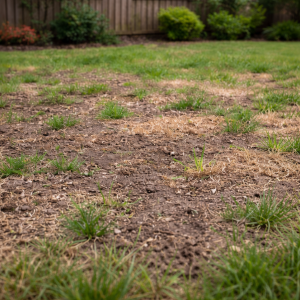
You’ll notice visible improvement within 3-4 weeks – the lawn greens up, density increases, and bare patches fill in.
But real results aren’t visible after a year or so.
- Year one may feel like nothing’s working as advertised as weed pressure increases mid-season as thick grass establishes.
- But by year two, weeds will decline noticeably, costs drop, and you see the payoff.
- Year three is when organic becomes obviously better than chemical management.
If you need instant results, organic isn’t for you. If you can commit through year two, the long-term benefits are substantial.
Will my lawn look worse during the transition from chemical to organic?
Possibly, temporarily.
As we mentioned earlier, weed pressure can ramp up exponentially during the first year. This catches people off guard because they expect immediate improvement. But this is normal and expected during transition.
What if I can’t afford to start organic lawn care right now?
Start small. You don’t need a comprehensive program immediately. Begin with soil testing ($65-$100) to understand what you’re actually working with. Once you know your pH, organic matter level, and nutrient availability, you can decide on a proper lawn care program later.
Is organic lawn care more complicated than chemical management?
It’s different, not necessarily more complicated.
Chemical management requires understanding which products to use and remembering application schedules. Meanwhile, organic management is all about understanding your soil’s specific needs and seasonal timing. Most people find that once they learn the seasonal pattern – spring for foundation work, summer for maintenance, fall for recovery – it becomes intuitive.
Can I do part of the work myself and hire professionals for the rest?
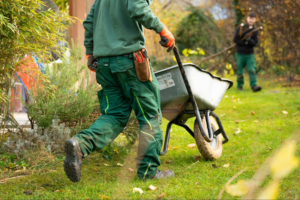
Yes, and most homeowners find this works best.
You can handle mowing, irrigation management, and hand-pulling weeds. Professionals should handle soil testing, aeration, and specialized amendments. This hybrid approach saves 20-30% on costs while ensuring critical work gets done correctly.
How much water should I use, and when?
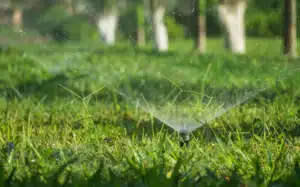
Aim for 1-2 inches per week during active growth, applied in one or two deep sessions rather than daily light watering.
Use the finger test: stick your finger 3-4 inches into soil. If it feels dry, water deeply. If it’s still moist, wait.
Water early morning (before 7 AM) to minimize evaporation and fungal disease. Deep, infrequent watering forces roots deeper and builds drought resistance. Shallow, frequent watering creates dependence on constant irrigation.
My lawn has been chemically treated for 10+ years. Can I still transition to organic?
Yes, but expect year one to be challenging.
Long-term chemical use suppresses soil biology and creates nutrient dependency. Your initial foundation work will be more intensive and aggressive aeration, multiple compost applications, and careful monitoring. The payoff is bigger too: by year three, your soil biology rebounds significantly.
Why does corn gluten meal have specific timing windows?
Corn gluten meal inhibits root development in germinating seeds. Apply too early (before soil reaches 55-60°F) and seeds haven’t started germinating yet, which equates to a wasted application. Apply too late and spring weeds have already germinated. The actual window is late March-mid-April for spring weeds, mid-August for late-season weeds.
What if I want to overseed but also use corn gluten meal?
Don’t use both simultaneously. Corn gluten meal affects all seeds, not just weeds. If you’re overseeding in fall (late August-September), skip the August corn gluten meal application. If you’re using spring corn gluten meal, wait until after spring overseeding has established (typically 3-4 weeks).
How do I know if my soil is actually improving?
Get a soil test annually during your transition. Track these numbers:
- pH (should gradually decrease toward neutral in alkaline Nampa soil)
- Organic matter (should increase from below 1% toward 2-3%), and
- Nutrient availability (not total nutrients, but what’s actually available to grass).
You’ll also notice practical changes: earthworms appear, soil becomes crumbly instead of hard clay, water infiltrates faster, and your lawn requires fewer interventions.
My property is in newer development. Is organic as necessary as it would be for an older lawn?
Newer properties have less accumulated damage: less compaction, less thatch, less suppressed biology. You’ll likely transition faster and smoother.
Why do organic programs include four fertilizer applications instead of one or two big applications?
One big spring application creates a growth flush that increases water demand and heat sensitivity during stress season. Four applications – early spring, late spring, early fall, late fall – deliver steady nutrient availability matching grass growth rates. Organic fertilizers release slowly anyway, so multiple smaller applications prevent wasting nutrients and align with your grass’s actual needs throughout the year.
What’s the difference between organic fertilizer and compost? Do I need both?
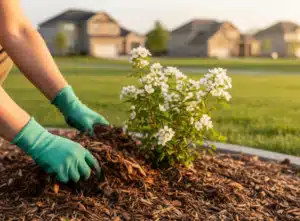
Compost is decomposed organic matter that improves soil structure and introduces beneficial microorganisms. It’s primarily soil amendment, not primary nutrient source.
Organic fertilizer provides nitrogen, phosphorus, and potassium needed for growth.
Ideally, you need both: compost to rebuild soil, fertilizer to feed the grass.
If I stop organic treatments, will my lawn go back to its chemical-dependent state?
Partially, yes.
Your soil’s biological improvement persists – earthworms won’t disappear immediately, organic matter doesn’t vanish overnight. But grass vigor might gradually decline. Weeds could resurface. The ideal is committing to organic as a long-term approach rather than experimental.
Can organic lawn care prevent all weeds, pests, and diseases?
No. Organic management prevents most problems by building a healthy lawn that naturally resists damage. Some weeds will always appear. Some pests might show up. The difference is you’re dealing with occasional problems instead of constant ones.
My water bill is high. Will organic lawn care really reduce irrigation costs?
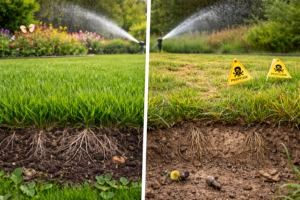
Yes, significantly. By year two or three, organically managed lawns typically need 20-30% less water than chemical-dependent lawns. This happens because deeper roots access water other lawns can’t reach, and improved soil structure holds moisture better.
What if I have pets or young children playing in the yard?
Organic management is specifically designed for family-safe lawns. No warning labels, no re-entry restrictions, no chemical toxicity concerns. Kids can pick dandelions, pets can roll in grass immediately after treatment.
Ready to start your transition? Schedule a free soil assessment with Organic Solutions to understand your specific lawn’s needs and timeline.